INVISIBLE
An honest look at the labor Moms provide
(and what we really want on Mother's Day)

Shamyra Evans has 3 boys and operates a part time laundering business focused on clothing organizing with hands on support, works another part time job as a learning on demand consultant and is going back to school for a career in speech language therapy. Two of her children and her husband are neurodivergent which adds another layer to managing the invisible labor because the systems she sets up to manage some tasks don't always work for every person. “It feels heavy and overwhelming,” she says. “A lot of days I don't feel like I'm enough or doing enough. Sometimes it feels daunting – like this never ending cycle. When you live in a neurodivergent household, no one thing works consistently all the time.”
Snuggles while reading a book, hearing them speak their first words, watching their little hands pick flower-weeds in the yard, feeling their arms squeeze tight around your neck - these are nothing short of some of the most magical moments in our lives as Mothers.
Yet - there's a quiet, unspoken weight we carry too, called invisible labor or the invisible load. The physical, mental, and emotional energy, often unseen, spent on tasks that surround parenting and day to day life. According to new research published in The Archives of Women's Mental Health, the majority of this cognitive labor is shouldered by Moms (in heterosexual relationships) creating stress, depression and burnout at high levels.
We're talking about more than just doing the laundry. We're keeping mental track of when kids outgrow clothes and get new ones when they need them, we're creating laundry systems that work in the family, and remembering things like when laundry soap needs to be replenished. We're keeping mental checklists that revolve around all kinds of parenting and life activities, anticipating needs, planning, organizing and delegating tasks. We're responsible for remembering sports sign ups, when our snack day is, making sure snacks are bought for said snack day, ensuring uniforms are ready to wear and kids are transported to practices and games. The invisible cognitive functions that families rely upon are great and mainly carried out by Moms.
I don't think there was one specific moment that lead to me feeling exhausted and overwhelmed from this quiet list of parenting and household tasks emphasized by a lack of systemic support like affordable childcare. It's like that frog in the water analogy where the water is slowly warmed up before the frog even becomes aware he is being cooked. One day I just realized how drained and annoyed I felt from being 'cooked' too long. The weight of daily tasks just felt like too much – and I began to wonder – do other Moms feel this way too? Am I failing at this? Why can't I do it all?
Step into any online Mom group and you will encounter a flurry of posts describing the burnout and stress associated with this weight. Moms are taking on 72% of the cognitive household labor. And we haven't even addressed systemic things like lack of universal paid parental leave, real affordable access to childcare in the early years or the motherhood tax (the pay gap and loss of career opportunities simply due to having a child). It's no coincidence that organizations like Fair Play have popped up, whose mission and purpose is to help couples re-distribute many of these tasks more equitably.
This series of photographs is a visual exploration and validation of the weight that many mothers feel as they carry this invisible load. These portraits are not singular mothers or experiences – they represent Motherhood and the tasks we perform every day that go unseen, undervalued and unpaid. These images convey the entire truth of motherhood; not just the hugs, snuggles and yard flowers but the things that can feel heavy too – the Invisible Load.
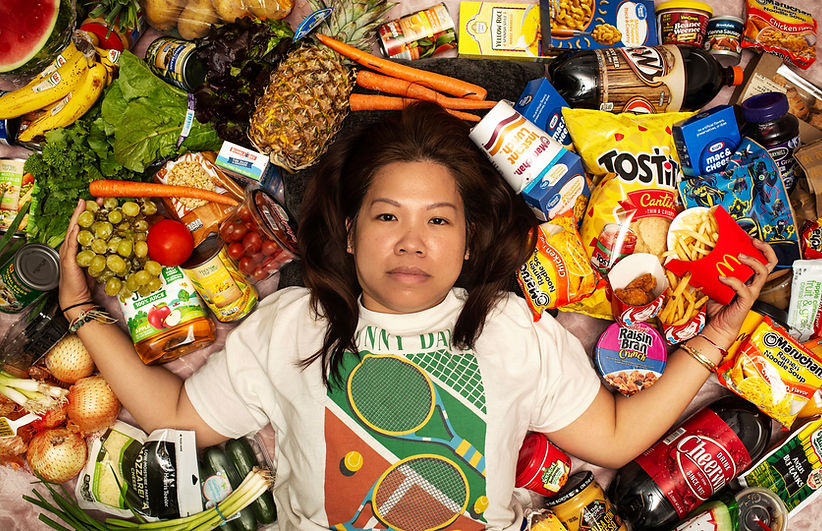
Lisa Nguyen has 4 children and is a business owner. As the person tasked with the food planning, the invisible weight and guilt associated with making sure her family is eating a balanced, nutritious diet versus fast food or foods not as healthy weighs heavy on her mind.

Brittainey Capps has 3 children and works full time in the ER as an RN. Kids sports sign ups, keeping track of schedules and transportation to these activities is her sole responsibility.

Alisha Khan has 2 kids and works full time as a Practice Lead at a software company. Managing the lists and family calendar of activities takes up a significant part of her mental energy and week. “All this feels exhausting and quietly disappointing… Like carrying something heavy that nobody else can see.”

Heather Foster has 2 children and works 40 hours a week. She worry that her kids might grow up thinking the most important thing to their mom is a clean house, simply because it is one of her sole responsibilities. She mentions that if other people in the house would carry a portion of this task it wouldn't be so overwhelming for her. “I feel like a ping pong ball,” she says, “getting pulled in all different directions.” Even so, Heather says she feels like she's not 'special' that this type of overwhelm is happening to lots of other moms too.

Eleanor Shell has 3 children and is the founder of Resilient Magnolia. She suffered a traumatic brain injury 2 years ago after being hit by a car. The injury has altered her brain so that it makes these everyday tasks harder to manage and keep up with. The mental task of sorting through and organizing kids toys feels nearly impossible. "I wasn't prepared for the amount of toys that kids have, all the pieces that go into toys, they just take over your whole life – it's hard to contain them. Its hard to limit them. It's just extremely overwhelming how quickly it comes at you – even if you don't let too much in they're just everywhere."

David Zealy has one child, is a psychology educator and therapist and has been performing in drag for 30 years. David identifies many aspects of his life within the role as a mother. When he adopted his son he took a break in performing drag so that he could focus solely on the needs of his child. After some years, he felt it was the right time to continue to pursue this art form that he considers an act of self-care, but it's always required a lot of effort to make it work. “It's a constant re-assessment of this

Madelyn Ziongas has 3 kids, homeschools her children and runs a flower truck and event business often working more than 60 hours a week. It's her responsibility to research schooling options, gather homeschool material, execute all subjects and coordinate all the extracurricular activities.

Ranika Chaney is a single mom of 5, and founder of Ranika Speaks and the executive director for Engage Art Her work is flexible, which means life and work often flow together. Some days look like answering emails while dinner is on the stove.

Felice Gwinn is a stay at home mom to her 3 children. Diapering and feeding babies often falls under the sole responsibility for lots of moms. Keeping track of diapering needs, cleaning diapers (in her case) and feeding children can often feel like a full time job in itself.

Jenny Rodriguez is a mother of 2 kids and works 40 hrs a week as a real estate investor. She is the primary parent responsible for taking care of the kids when they get sick and keeps track of scheduling all the doctor appointments and getting the kids to the appointments.

Randi Robinson is a stay at home mom to twin boys because her and her spouse quickly realized childcare would eat up an entire salary. The unseen mental labor of organizing kids art, their paperwork and generally the family's paperwork can be endless.

Natalie Poe has two kids and is a stay at home mom. The mental labor of sifting through mountains of
parenting books and resources can feel never-ending. Some moms like Natalie simulatnously parent while
healing their own childhood trauma. "Healing from trauma while parenting feels bittersweet. It's nurturing them while I heal my inner child. It's being conscious of separating them from a younger version of myself and learning to mother them as unique individuals. I have to learn how to be who they need me to be, not necessarily who little Natalie needed. I end up overcompensating a lot and end up burntout."
We see you, Mama. You aren't failing. You ARE exhausted and overwhelmed and even possibly depressed because juggling all these things does come at a cost. Making this weight more bearable is about taking an honest look at all of the factors contributing to this collective, invisible labor like: the structures in our society that uphold this weight (hello unpaid parental leave) and real conversations with our partners about our needs (more equitable distribution of cognitive labor) and some of it (dare I say) is about letting go of the expectation to do it all.
What do Moms really want on Mother's Day?
We want a more fair and balanced portion of the invisible load. In practical terms it means we need our partners to take ownership of tasks from beginning to end including the mental planning, execution and monitoring of that specific activity. We need to keep fighting for things like legislation for free and affordable childcare. And we need our communities to care.
And of course - we'll always want a few of those yard flower-weeds.